
Contents
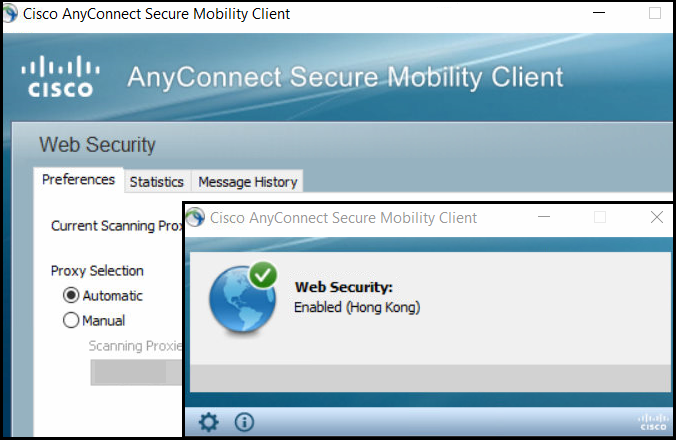
A VPN connection will not be established. AnyConnect was not able to establish a connection to the specified secure gateway. Please try connecting again.” To fix this, make sure there is no other local user logged into this computer other than you. If you are not sure whether or not others have logged in. Jan 12, 2013 AnyConnect was not able to establish a connection to the specified secure gateway. 5 Responses to How to fix “AnyConnect was not able to establish a connection.
Introduction

This document describes what to do when you enounter this Cisco AnyConnect Secure Mobility Client VPN User Message:
Prerequisites
Requirements
There are no specific requirements for this document.
Components Used
The information in this document is based on Windows Vista and Windows 7 operating systems only.
The information in this document was created from the devices in a specific lab environment. All of the devices used in this document started with a cleared (default) configuration. If your network is live, make sure that you understand the potential impact of any command.
Background Information
The Base Filtering Engine (BFE) Service
BFE is a service that manages firewall and Internet Protocol security (IPsec) policies and implements user-mode filtering. The security of the system is significantly reduced if you stop or disable the BFE service. It also results in unpredictable behavior in IPsec management and firewall applications.
These system components depend on the BFE service:
- Internet Key Exchange (IKE) and Authenticated Internet Protocol (AuthIP) IPsec Keying Modules
- Internet Connection Sharing (ICS)
- IPsec Policy Agent
- Routing and Remote Access
- Windows Firewall
The AnyConnect Secure Mobility Client makes both routing and remote access changes to the host machine. The IKEv2 is also dependent on the IKE modules. This means that, if the BFE service is stopped, The AnyConnect Secure Mobility Client cannot be installed or used to establish a Secure Sockets Layer (SSL) connection.
There are threats in active circulation that disable and remove the BFE service as a first step in the infection process.
Win32/Sirefef (ZeroAccess) Trojan
Win32/Sirefef (ZeroAccess) trojan is a multi-component family of malware that uses stealth to hide its presence on your computer. This threat gives attackers full access to your system. Due to its nature, the payload might vary greatly from one infection to another, although common behavior includes:
- Download and execution of arbitrary files.
- Contact of remote hosts.
- Disablement of security features.
There are no common symptoms associated with this threat. Alert notifications from installed antivirus software might be the only symptoms.
Win32/Sirefef (ZeroAccess) trojan attempts to stop and delete these security-related services:
- Windows Defender Service (windefend)
- IP Helper Service (iphlpsvc)
- Windows Security Center Service (wscsvc)
- Windows Firewall Service (mpssvc)
- Base Filtering Engine Service (bfe)
Caution: Win32/Sirefef (ZeroAccess) trojan is a dangerous threat that uses advanced stealth techniques in order to hinder its detection and removal. As a consequence infection with this threat, you may need to repair and reconfigure some Windows security features.
Problem
The scenarios are:
- The user cannot install the AnyConnnect Secure Mobility Client and receives the error message, 'The VPN client was unable to setup IP filtering. A VPN connection will not be established.'
- The AnyConnect Secure Mobility Client worked fine initially. However; the end user can no longer establish a connection and receives the error message, 'Anyconnect was not able to establish a connectoin to the specified secure gateway. Please try connecting again.'
Solution
When these error messages are seen, it is important to confirm whether the BFE is actually disabled/missing or if the client is not able to recognize it. In order to troublehoot, complete these steps:
- Access the Service Control Manager (SCM) from the Windows menu:
- Search for the BFE service in order to confirm its presence or absence.
If the service works, the status displays as Started. If there is anything else in that column, there is a problem with the service. However, if the status displays as started, the client is clearly not able to communicate with the service, and it is possible there is a bug.
If the service is disabled or not started, some possible reasons are:
- Malware, as previously explained, disables this service as a first step.
- Registry corruption on the machine.
Repair Procedure
The first step is to scan and disinfect your system with an antivirus software. You should not restore the BFE service if it will be deleted again by Win32/Sirefef (ZeroAccess) trojan. Download the ESET SirefefCleaner tool from this web page, and save it to your desktop.
This video explains the procedure to remove the Win32/Sirefef (ZeroAccess) trojan:.
Once you have removed Win32/Sirefef (ZeroAccess) trojan, verify that the BFE service can be started and kept active by normal means. In order to do this:
- Start SCM and choose the Extended tab instead of the Standard.
- Choose the BFE service.
- Choose the Start option on the left.
Caution: It is a good practice to back up your files before you attempt this procedure. All information in this article is provided as is, without any warranty, whether express or implied, of its accuracy, completeness, or fitness for a particular purpose.
If this procedure does not work, complete these steps:
- Download the ESET ServicesRepair utility from this web page, and save it to your desktop.
- Execute the ESET ServicesRepair utility.
- Follow the prompts in order to repair the BFE service.
- Once the utility finishes, restart your computer.
- Once your computer restarts, install or execute The AnyConnect Secure Mobility Client again.
Note: Tests have shown that this tool helps in most cases where the registry files are corrupt or services are damaged. Therefore, if you encounter these error messages, this tool proves useful too:
- The VPN client agent was unable to create the interprocess communication depot.
- The VPN agent service is not responding. Please restart this application after a minute.
- The Cisco Anyconnect Secure Mobility Agent service on Local Computer started and stopped. Some services stop automatically if they are not in use by other services or programs.
I was trying to log into work but had trouble making a VPN connection. I use Cisco AnyConnect VPN Client. This post describes how to fix the following error messages when using Windows 8 Pro:
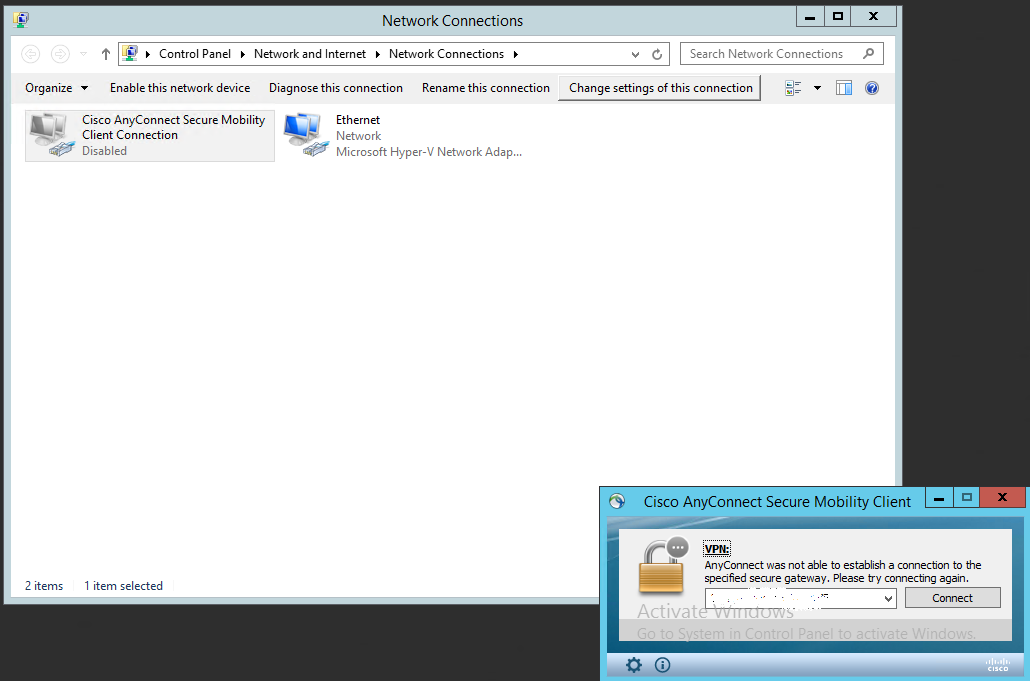
- AnyConnect was not able to establish a connection to the specified secure gateway. Please try connecting again.
- The VPN client driver encountered an error. Please restart your computer or device, then try again.
The steps to fix this problem are as follows:
1. Edit a registry entry by running a program called regedit. Right-click on it and Run as administrator. Note that I use Start8, by Stardock, to have a Start button and menu. After you left-click on Run as administrator, your computer might ask you to enter the admin password.
2. Go to the appropriate VPN registry directory called ComputerHKEY_LOCAL_MACHINESYSTEMCurrentControlSetServicesvpnva
3. Double left-click the DisplayName key.

An Edit String pop-up window will appear.
The text under the Value data: field on my computer looked like this.
@oem20.inf,%vpnva_Desc%;Cisco AnyConnect VPN Virtual Miniport Adapter for Windows x64
4. Change the field to
Cisco AnyConnect VPN Virtual Miniport Adapter for Windows x64
Anyconnect Not Able To Establish Connection To The Specified Secure Gateway
by removing all the text and characters that are on the left of the word Cisco.
The end result should look like this:
5. Left-click the ‘OK’ button.
Anyconnect Was Not Able To Establish A Connection Mac
6. Exit the Registry Editor
7. Run Cisco AnyConnect VPN Client and reconnect.
That’s all there is to it. Good luck!
Update : 2/13/2014
I recently updated my computer on February 13, 2014 with Microsoft’s updates and saw that the text under the Value data: field on my computer looked like this:
@oem10.inf,%VPNVA64_Desc%;Cisco AnyConnect Secure Mobility Client Virtual Miniport Adapter for Windows x64
It is different from what I had originally posted. I’m not really sure how or why it changed and I don’t have time to find out. I also updated to Cisco AnyConnect Secury Mobility Client Version 3.1.04066. As far as I can tell, the value of …
@oem10.inf,%VPNVA64_Desc%;Cisco AnyConnect Secure Mobility Client Virtual Miniport Adapter for Windows x64
Client Unable To Establish Connection
.. works, but the value of
Cisco AnyConnect VPN Virtual Miniport Adapter for Windows x64
does not work with Cisco AnyConnect Secury Mobility Client Version 3.1.04066.
Update : 2/15/2014
Changing the Value data: field to
Cisco AnyConnect Secure Mobility Client Virtual Miniport Adapter for Windows x64
without
@oem10.inf,%VPNVA64_Desc%;
Anyconnect Not Able To Establish Connection With Router
seems to work better, too.